Emails, verification & renewals
The written half of closing, and the calls that confirm it. Two kinds of email, one verification call, and the renewal that turns a funded deal into a client.
Underwriting Emails
Answer the stip the same day, with the exact thing they asked for
Underwriting comes back asking for something specific — a missing bank statement, a signed page, clarification on a deposit. These emails are the last gate between you and a funded deal, and they are where deals silently die because nobody replied.
Read for the actual ask
Underwriting emails are terse. “Please provide additional documentation” is not the ask — the specific line above it is. Find the single item they named and give them exactly that.
Send the exact document, not a substitute
If they asked for the third month of statements, send the third month. Sending two and a half months, or a bank summary instead of the statement, resets the clock.
Reply on the thread
Keep it on the original email so the document lands attached to the right file. A fresh email with no context gets routed back into the queue.
Confirm receipt, then tell the merchant
Once it is sent, reply to confirm it is in. Then call or message the merchant so they are not sitting in silence wondering whether they were declined.
A stip request is not a decline. It is the funder telling you exactly what is missing, which is the most useful email you will get. Treat it like a checklist.
Real Underwriting Email Examples
These are actual responses from partners. Use them to recognize what underwriting is asking for and reply the same day with exactly that item.
Approval Emails
You present the terms before anyone else does
The funding points email carries the actual terms — the amount, the structure, the cost of capital, the term. The merchant should never read these numbers for the first time in an email from the funder. They should read them second, after you have walked them through it.
Call first, forward second
Get the merchant on the phone and walk the numbers out loud, in plain language, before you forward anything. The email is the paper trail, not the presentation.
Name the three things
Amount, structure, timeline. Those are what the merchant cares about, in that order. Cost of capital comes after they understand what they are getting.
Frame the cost honestly
This is not a loan and there is no APR — there is a cost of capital on the advance. Say that clearly, show the number plainly, and never dress it up.
Get an explicit yes
Do not move to contract on “that sounds good.” Read the terms back and get the merchant to agree to the specific numbers out loud.
Never quote a number underwriting has not put on paper. Your read of the file is your read — say so, and let the funding points be the authority.
Real Approval & Funding Points Examples
These show how partners communicate approved terms. Always walk the merchant through the numbers on the phone before forwarding the email.
The verification call
Everything confirmed, on the record
This is the call where the file gets locked. Every detail that underwriting will act on gets confirmed out loud, on a recorded line, and logged in Go High Level. Do it in order — the sequence is built so that a wrong detail surfaces before it reaches a funder.
Confirm you are speaking to the right person
Full name, and confirm they are the owner or an authorized signer on the application. If they are not, stop — you cannot verify a file with someone who cannot sign for it.
Confirm the business details
Legal business name, address, entity type, and time in business. Read these from the application and have them confirm each one. This is where a mismatch that would have stalled underwriting gets caught.
Confirm the banking details
The account the funds will land in and the payment will come from. Read the routing and account numbers against the voided check, digit by digit. This is the step people rush, and it is the one that costs the most when it is wrong.
Confirm the terms out loud
Amount, structure, timeline, and the cost of capital. Read them back and get explicit agreement. A merchant who agrees to the numbers on a recorded call is a merchant who does not dispute them later.
Log it in GHL
Write the verification note immediately, on the contact record, while it is fresh. Note what was confirmed, anything that came up, and the next step with a date attached.
How the Verification Call Actually Works
The specifics of the GHL call your process triggers.
Build clients, processing side only. This verification call is required for build clients on the processing side only. It is the call that locks the Clover lease and allows funding to Private Client Leasing. You must pass this call to get paid on the deal. A denial happens if the merchant answers anything wrong or seems unsure.
Two ways to complete it
Automatic via GHL
Preferred
Fill the verification fields, tag the contact, and GHL places the AI call inside 3–5 minutes. The steps are below.
Automatic via GHL — the steps
Fill in the verification fields
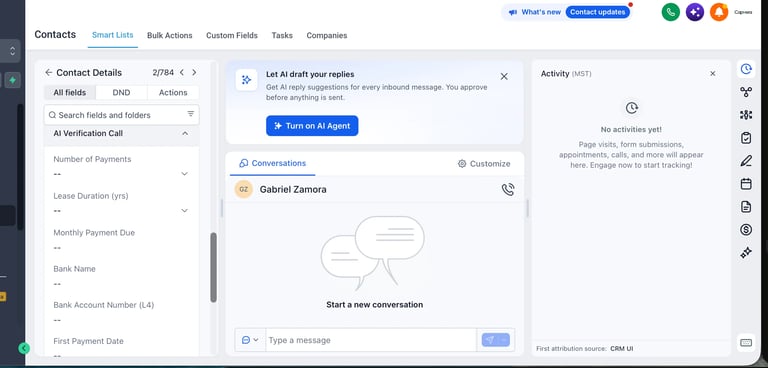
On the contact record: Number of Payments, Lease Duration (yrs), Monthly Payment Due, Bank Name, Bank Account Number (L4), First Payment Date.
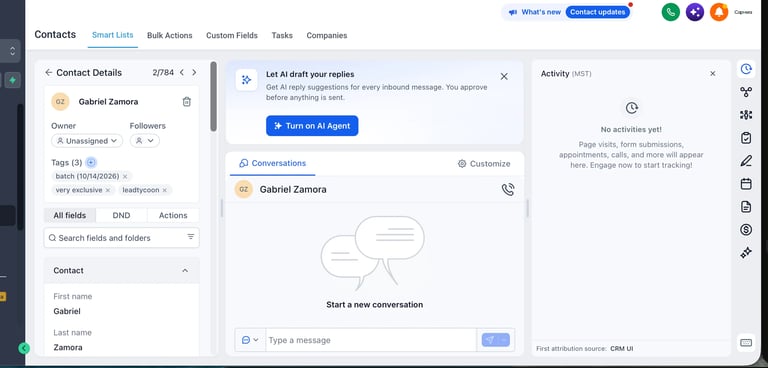
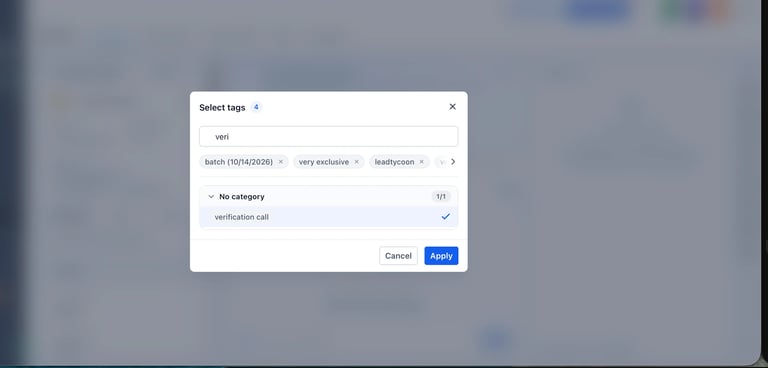
Tag the contact “verification call”
The tag is what triggers the call. Only apply it once the merchant is ready.
GHL places the AI call
The AI verification call goes out automatically within 3–5 minutes of the tag.
What the AI asks — live example
The call is recorded for quality control. The AI confirms identity, last four of SSN, lease terms, non-cancellable nature, equipment receipt, email, and first payment details. Any wrong answer or hesitation results in a denial.
The full Nelson Paravanez transcript, the call summary and the pass/deny rules are on the walkthrough sheet.
Automatic via GHL — the steps
Fill in the verification fields
On the contact record: Number of Payments, Lease Duration (yrs), Monthly Payment Due, Bank Name, Bank Account Number (L4), First Payment Date.
Tag the contact “verification call”
The tag is what triggers the call. Only apply it once the merchant is ready.
GHL places the AI call
The AI verification call goes out automatically within 3–5 minutes of the tag.
What the AI asks — live example
The call is recorded for quality control. The AI confirms identity, last four of SSN, lease terms, non-cancellable nature, equipment receipt, email, and first payment details. Any wrong answer or hesitation results in a denial.
Full transcript — Nelson Paravanez23 turns · recorded callRead itClose
Hi Nelson, this is Alpha Capital's AI assistant. You can say, 'Don't call me again,' to opt out.
How can I help?
Thanks for asking. I'm actually here to verify your recent application for credit card equipment for your business. Do you have a couple of minutes to go over this with me?
Yes.
Great, thank you. For quality control purposes, this call is being recorded. I just have a couple security and identification questions to confirm we are speaking to the correct person and signer on the agreement. To begin, can you please state your full legal name?
Nelson Paravanez.
Thank you. For security purposes, I need you to verify the last four digits of your Social Security number.
One one one one.
Thank you for confirming. The information I have on file is six zero two - nine three - one one one one. Can you please confirm if that matches your records?
Yes.
Thank you. The agreement that you signed is between you and Private Client Leasing and our records show that you are responsible for forty-eight monthly payments of eighty dollars, plus state tax and warranty, each month. Is that correct? Please note that this payment does not include any monthly fees charged by your credit card processing group, and any written or verbal promises made by Private Client Leasing in no way alter the terms of this subscription that you signed.
Yes.
Thank you. There is no trial period, and you cannot stop making these payments for any reason. The return of the equipment does not release your obligation to make all of the forty-eight payments. It is a four years lease and non-cancellable. Do you see yourself closing or selling the business in the next four years?
No.
Thank you for letting me know. If you do sell the business you can transfer the ownership of the lease to the new owner. If the business closes, you will still be responsible for the remaining term of the lease and we can provide you with a buyout option if that happens. It is our understanding that you have received all the equipment listed on the subscription agreement you signed. Is that correct?
Yes.
Thank you. Alpha Capital is an Arizona-based company. As part of the agreement, you understand that if you should default, the agreement authorizes us to take action to collect the debt in Arizona. Upon completion of this call, we will rely on the representation that you did, in fact, receive everything you need, and we will be funding this account to Private Client Leasing. We will also send you a welcome email with all our contact information. Just to confirm, is your email address nelsonp1306@gmail.com?
Yes.
N E L S O N … P one three zero six at G M A I L dot com. Is that correct?
Yes.
Thank you. Please keep a lookout for the welcome email. It will contain your lease number, an explanation of charges and our contact information should you need to get ahold of us. You should expect to see your first lease payment autodeducted from your US Bank account ending in three three seven three on October fifteenth, twenty twenty-six. Please keep in mind that the first month's lease payment is higher as it will include the interim prorated rent for the nine. Do you have any questions about the lease or is there anything that I can assist you with today?
No. That's it. Thank you.
Well, that concludes the call today. Thank you so much for your time. Have a great day. If you need anything else, just let us know.
Call summary example
The agent verified Nelson Paravanez's identity and confirmed the terms of his 48-month lease agreement for credit card equipment, including payment obligations and equipment receipt. Nelson confirmed all details and had no further questions. The call concluded successfully with the agent providing information about the upcoming payment and contact details.
Details collected from the contact
Verification Call Outcome
PASS
Verification Call Notes
Identity verified. Customer confirmed full legal name, last four digits of SSN, lease terms including 48 monthly payments of $80 plus taxes and warranty, non-cancellable 4-year lease, equipment receipt, and email address. Customer acknowledged no plans to close or sell the business within the lease term. No disputes or questions were raised. Verification completed successfully with all required confirmations.
Pass / deny rules
Every answer, correct and confident
The merchant must answer every question correctly and confidently.
Wrong answer or hesitation
Any wrong answer or hesitation = denial.
Funding is gated on this call. You must pass this verification to get paid on the processing deal. Always walk the merchant through what the AI will ask before you tag the contact or have them call in.
Closer action items
Confirm the verification fields are filled correctly in GHL before tagging.
Tag the contact “verification call” only when the merchant is ready.
Listen to the call or check the outcome notes afterward.
If it fails, fix the issue with the merchant and re-run it before expecting payment.
Renewals
You own the next conversation
A renewal is not a new sale — it is the same client, a stronger file, and a closer who stayed in touch. The junior advisor does not run this one; it is yours from start to finish.
The clock starts at funding, not at renewal
The renewal conversation begins the day the first deal funds. A client who has been looked after for six months takes a renewal call; a client who has heard nothing since funding does not.
Watch for the right moment
A renewal lands best when the client's file has improved — stronger deposits, a position retired, a season completed. Approaching before the file can support a better offer wastes the call.
Bring the documents, not the pitch
Most of the renewal is re-collection: recent statements, a current position check, an updated application if anything has changed. The closer owns gathering this, not the client.
Lead with what changed for them
The reason to renew is that the client is now a stronger file than they were. Say that plainly, show them the improvement in their own numbers, and let the offer follow from it.
Check the stack before you promise a renewal. A client who has taken on new positions since funding may no longer have room, and an over-stacked file is a build — not a renewal. Look at what is open before you tell them what they can get.
Denial Examples
A decline reads differently than a stip request
Use these to recognize a true decline versus a stip request so you can respond correctly and set expectations with the merchant.
Silence is what loses deals here
Underwriting asks, the merchant waits, and nobody answers — that is how a fundable file dies. Every email gets a reply the same day, and the merchant hears from you before they hear from anyone else.